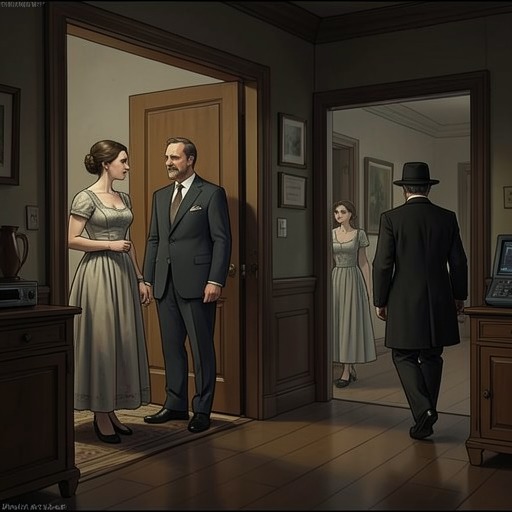
Steering School Infirmary Annex
The World According to GarpThe Steering School Infirmary Annex was both Jenny Fields’s workplace and the home in which she raised T. S. Garp through his childhood and school years. Set within an all-boys’ institution, it joined domestic life to medical care: its apartment, wards, and underground connection to the main infirmary made the school’s injuries, rules, and routines part of Garp’s everyday world. That overlap gives the annex a lasting narrative importance, from the circumstances of his upbringing to the place where his first sexual experience occurred.
Setting and Jenny’s Choice
Jenny might have taken a nursing position at an all-girls’ school, where she and Garp would have been offered an apartment in a dormitory. She declined, imagining the environment as potentially difficult for her son, and accepted a position at the much larger Steering School instead. Its apartment for them was in the cold, prison-windowed wing of the infirmary annex. The school admitted boys only, and Jenny’s father regarded it as a suitable place for Garp’s education, though he objected to Jenny working when the family had money enough for her to withdraw to Dog’s Head Harbor.
The annex also made visible the unusual terms of Jenny and Garp’s family life. Jenny did not invent a marriage or a story about Garp’s father to make her son’s birth appear legitimate. She insisted on her own name, Fields, and on her son’s name, Garp, presenting it as his own. In a community where pride and social standing mattered, the unmarried nurse’s forthrightness drew notice. The annex was therefore more than staff housing: it was the place where Jenny raised Garp openly, without disguising his parentage or apologizing for their household.
A Home Inside the School’s Medical World
When Garp was five, Jenny became head nurse. She was well suited to the work and content to remain in her wing of the annex, where she cared not only for her son but also for the school’s boys. Her duties brought her out at night to answer calls, attend to sickness, and manage the consequences of the boys’ energetic and sometimes reckless behavior. They raced hospital beds, fought in wheelchairs, and tried to climb the ivy-covered buildings; their disorder belonged as much to the annex’s life as the routines of treatment did.
An underground tunnel connected the annex to the main infirmary. It was wide enough for a wheeled bed and two nurses, but the boys sometimes used it for games, bowling there when they should have been elsewhere. The tunnel made the annex physically part of a larger medical complex while also offering a concealed route through the institution. Garp learned its layout over the eighteen years he lived there, knowledge that later allowed him to move through the buildings without drawing his mother’s attention.
The annex’s clinical atmosphere extended beyond its corridors. During the war, Jenny worked in intensive care at Boston Mercy Hospital, where she saw soldiers among the terminal patients and devised categories for their injuries. The wounded Technical Sergeant Garp was brought there, difficult for her to classify: he had sustained brain damage and burns, and his speech was largely reduced to the word Garp. This larger nursing history echoes the annex’s role in Jenny’s life. Medical work was not separate from her identity as a mother; the habits of attention and care that defined her work also shaped her household.
Garp’s Childhood and the Missing Child
The annex allowed Garp to wander through parts of the infirmary and speak with patients, though Jenny set limits on which rooms he could enter. He liked the casts, slings, and bandages associated with athletic injuries, and he enjoyed hearing patients explain how they had been hurt. Like his mother, he ran errands, delivered messages, and sometimes smuggled food to them. His freedom was therefore real but bounded by the institution’s rules and by Jenny’s practical vigilance.
That vigilance became acute one night when Garp, then five, did not answer Jenny’s call over the intercom. Because the announcement reached both the infirmary and the annex, his silence suggested that he might be in trouble or outside the buildings. Jenny organized a search among the more mobile patients and checked dangerous places, including the laundry chute and boiler room. The episode draws its tension from a familiar feature of the annex: the same network of rooms that made Garp’s roaming and helpfulness possible also contained spaces from which a child might not return promptly. The available account emphasizes Jenny’s search and the building’s hazards, rather than resolving the episode through a simple domestic setting.
The Annex at Graduation and First Love
Garp remained at the annex until his graduation from Steering. On graduation night, the infirmary and annex were empty of students, their beds stripped, while Jenny and Garp sat together in their apartment and drank beer. Garp felt let down and questioned whether the occasion was an anticlimax. Jenny answered by setting his four years at Steering against her own eighteen years at the school. When she fell asleep after less than two beers, Garp carried her to bed and carefully removed her nurse’s pin so it would not hurt her. The gesture places their closeness within the familiar routines of the annex: the son she had raised there was now able to care for her.
Later that night, Garp returned to the school and brought Cushie Percy into the infirmary through the underground tunnel. He took her to a distant wing near the surgery and anesthesia rooms, away from Jenny’s apartment. The encounter made the annex’s medical surroundings part of Garp’s private adult memory: his first sexual experience was associated with the quiet, deserted institution in which he had grown up. He and Cushie had known each other for years, and the scene joins a coming-of-age threshold to the school’s familiar architecture rather than to a world outside it.
Their privacy did not last. Before dawn, Stewart Percy woke them by calling from the lawn, with Bonkers beside him, and Jenny appeared in the lit window. The interruption brings the annex’s domestic and institutional roles together once again: the school is a refuge familiar enough for Garp to navigate in darkness, but it is also Jenny’s home and workplace, where a disturbance can bring her into the scene. As a setting, the annex carries Garp from childhood toward adulthood without ceasing to be the place governed by his mother’s care and the school’s rules.
Narrative Significance
The annex connects events that might otherwise seem separate: Jenny’s nursing, her decision to raise Garp alone, his childhood among injured boys, and his graduation-night encounter with Cushie. Its design makes those connections concrete. The apartment opens onto wards; the tunnel links family space to clinical space; the school’s rooms provide both rules and routes for evasion. Garp’s intimate life begins not by leaving that environment but by finding a private corner within it.
The setting also anticipates the later importance of nursing and recovery in the family. After the car accident that injures Garp, Helen, and Duncan, Jenny again takes on a nursing role, and the family moves to Dog’s Head Harbor to recover. The later household is explicitly described as a hospital, while the earlier annex had already taught Garp that care, vulnerability, and ordinary family life can occupy the same space. Its significance rests less on a single architectural feature than on this repeated arrangement: a home inside an institution, where Jenny’s work and motherhood are inseparable and where Garp’s formative experiences unfold amid the practical realities of illness and care.